POS System
Coffee POS
CafeOS is a comprehensive cloud-based Point of Sale (POS) and restaurant management platform designed specifically for cafés, coffee shops, bakeries, and restaurants. The system centralizes every aspect of daily operations—including table management, order processing, reservations, inventory, employee management, reporting, and cashier operations—within a clean, intuitive, and highly scalable interface built for fast-paced hospitality environments.
Project Overview
CafeOS
Modern Cloud POS & Management System for Cafés and Restaurants
CafeOS was created to modernize the way cafés and restaurants operate by replacing fragmented workflows and manual processes with a unified digital ecosystem. The objective was not simply to build another POS application, but to create an intelligent operational platform capable of managing the entire business from a single dashboard while remaining simple enough for employees to learn within minutes.
The project started with an in-depth analysis of restaurant workflows, identifying common operational bottlenecks that occur during busy service hours. Managers often struggle with scattered information across multiple systems, while cashiers and waiters need immediate access to tables, orders, reservations, and payments without navigating through complicated interfaces. CafeOS was designed to eliminate these inefficiencies by organizing every operational task into a logical workflow that minimizes clicks and maximizes productivity.
A major challenge throughout the design process was balancing simplicity with the large number of business management features required by modern restaurants. Instead of overwhelming users with complex dashboards, the interface prioritizes clarity by presenting only the information relevant to each role. Large interactive components, consistent layouts, contextual actions, and carefully structured navigation ensure that both experienced staff and new employees can perform tasks quickly without unnecessary training.
One of the core modules of CafeOS is the intelligent floor management system. Restaurants can organize multiple dining areas such as indoor seating, terraces, VIP lounges, or private rooms while monitoring table availability in real time. Every table displays its current status, active order, seating capacity, service duration, and total bill, allowing staff members to immediately understand restaurant occupancy without opening additional screens. Opening new orders, transferring tables, merging bills, or closing payments becomes a seamless part of the service workflow.
Order management was designed to accommodate both traditional table service and takeaway operations. Employees can create, modify, split, or transfer orders while the kitchen receives updates instantly. Real-time synchronization ensures that multiple staff members can work on the same order simultaneously without data conflicts. This significantly improves communication between waiters, cashiers, and kitchen staff while reducing operational errors during peak service hours.
Reservation management represents another important aspect of the system. CafeOS allows businesses to organize customer bookings, monitor reserved tables, and optimize seating capacity throughout the day. Managers can instantly view reservation schedules alongside current occupancy, helping restaurants maximize customer flow while avoiding overbooking or idle tables.
Inventory and product management were designed to simplify stock control without requiring dedicated inventory software. Restaurant owners can organize products into categories, monitor stock availability, update pricing, manage menu items, and maintain consistent product information across the entire platform. This integration reduces duplicate work while ensuring that menu availability always reflects current inventory levels.
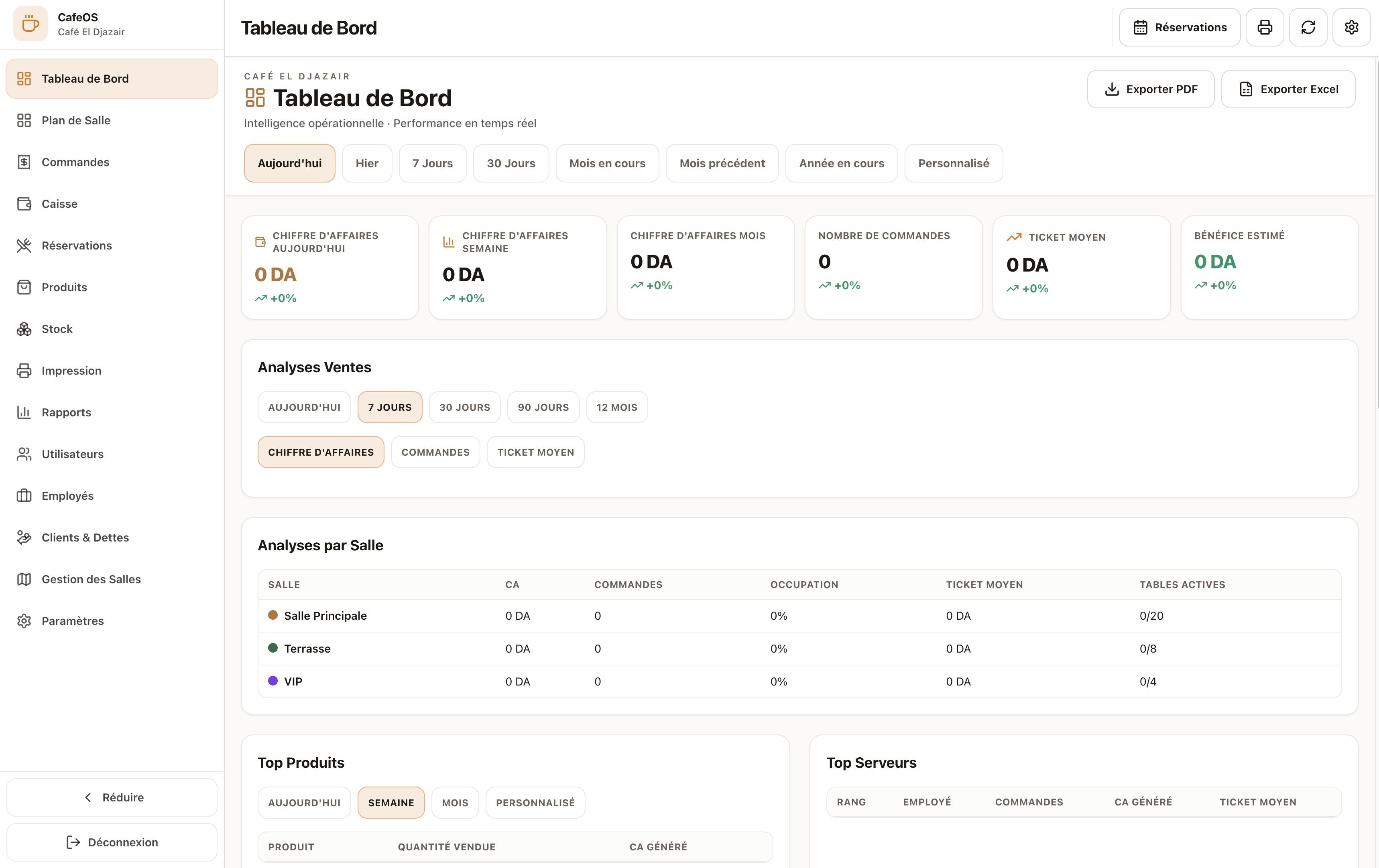
The cashier workspace was developed as a complete financial control center rather than a simple payment screen. Cashiers can manage opening and closing shifts, process multiple payment methods, issue receipts, register refunds, monitor cash drawer balances, and review transaction history from one unified interface. Real-time financial indicators provide immediate visibility into revenue, average ticket size, total orders, estimated profit, and operational performance throughout the business day.
Business intelligence plays a central role in CafeOS. Restaurant managers require actionable insights rather than raw numbers, so the reporting system transforms operational data into interactive dashboards that visualize revenue trends, product performance, employee productivity, payment distribution, occupancy rates, and customer activity. Advanced filtering allows reports to be analyzed by period, employee, dining area, payment method, or product category, enabling informed business decisions based on real operational data.
User management and access control were designed with enterprise-level security in mind. Different employee roles—including administrators, managers, cashiers, waiters, and kitchen staff—receive personalized permissions that limit access only to the functions required for their responsibilities. Authentication, session monitoring, audit logs, and activity tracking provide an additional layer of operational security while ensuring accountability across the organization.
Designing CafeOS required careful attention to usability across long working hours. The interface adopts a clean, minimal visual language with generous spacing, neutral backgrounds, soft accent colors, and clear typography that reduce cognitive load while maintaining excellent readability. Instead of relying on decorative elements, color is used purposefully to communicate operational states such as available tables, occupied tables, reservations, financial indicators, alerts, and system status, allowing employees to interpret information instantly.
From a technical perspective, CafeOS was architected as a scalable full-stack application capable of supporting businesses ranging from independent cafés to multi-location restaurant chains. The frontend architecture is well suited for implementation using React, Next.js, TypeScript, and Tailwind CSS, providing responsive performance across desktops, tablets, and touch-enabled POS terminals. The backend was planned using Node.js, Express.js, PostgreSQL, and Prisma ORM, while Socket.IO enables real-time synchronization between multiple workstations. Authentication is secured through JWT, with role-based authorization protecting sensitive business operations.
Several usability iterations were completed throughout development to refine navigation, simplify workflows, and reduce employee interaction time. Early prototypes contained excessive menu complexity and information density, which slowed operation during busy service periods. Through repeated testing and interface refinement, navigation was simplified, actions were consolidated, and reusable design components were introduced to create a faster and more intuitive experience.
The final result is a complete restaurant management ecosystem that extends far beyond traditional point-of-sale software. CafeOS combines table management, reservations, cashier operations, inventory control, employee administration, reporting, analytics, and real-time collaboration into one cohesive platform. By centralizing every operational process, the system helps restaurants improve service speed, reduce human error, gain better financial visibility, and deliver a more efficient experience for both staff and customers.
Developing CafeOS significantly strengthened my expertise in designing complex business management systems where usability, scalability, performance, and operational efficiency must coexist. The project demonstrates how thoughtful UX architecture and modern full-stack technologies can transform complicated restaurant workflows into a seamless digital experience.
Technologies
Design
Figma
Design System
Auto Layout
Components & Variants
Interactive Prototyping
User Flow Design
Information Architecture
Frontend
React
Next.js
TypeScript
Tailwind CSS
Backend
Node.js
Express.js
Database
PostgreSQL
Prisma ORM
Real-Time Communication
Socket.IO
WebSockets
Authentication & Security
JWT Authentication
Role-Based Access Control (RBAC)
Secure Sessions
Audit Logs
User Permissions
Core Features
POS System
Restaurant Dashboard
Table & Floor Management
Order Management
Reservation System
Cashier Workspace
Inventory Management
Product Management
Employee Management
User & Permission Management
Reports & Analytics
Business Intelligence Dashboard
Sales Reporting
Payment Tracking
Multi-Payment Support
Receipt Printing
Shift Management
Customer Management
Multi-Room Support
Real-Time Synchronization
Responsive Design
Cloud Architecture
Admin Dashboard
Project Information
- Category
- POS System
- Last updated
- August 18, 2026