Mobile App
Fitwave Gym website & Mobile App
FitWave is a modern fitness ecosystem that combines a responsive website with a mobile application to help users achieve their fitness goals through personalized workout programs, professional coaching, progress tracking, and an integrated fitness marketplace. The project focuses on delivering a seamless user experience across both web and mobile platforms.
Project Overview
FitWave
Website & Mobile Application
Overview
FitWave was designed as a complete digital fitness ecosystem rather than a traditional gym website or workout application. The vision behind the project was to create a platform where users could discover personalized workout plans, communicate with professional coaches, monitor their physical progress, and purchase fitness products without leaving the application. Instead of separating these services across multiple platforms, the experience was unified into a single product that works consistently on both mobile devices and desktop browsers.
The project was approached as a full product design challenge, where every screen had to support a clear user journey while maintaining a consistent visual identity across the entire ecosystem.
⸻
The Challenge
One of the biggest challenges was reducing the complexity commonly found in fitness applications. Many existing products overwhelm new users with large amounts of information before understanding their personal goals. This often leads to poor onboarding experiences and low user retention.
Another challenge was creating a product that could serve different types of users. Beginners needed a simple and guided experience, while experienced athletes expected quick access to advanced workout programs. At the same time, trainers required an interface that allowed them to organize exercises and manage their athletes efficiently.
The platform also needed to integrate an online store without making the application feel crowded or difficult to navigate.
⸻
My Approach
The design process started with user research and competitor analysis to understand how successful fitness platforms structure their onboarding experiences, workout navigation, and coaching systems.
Instead of designing individual screens immediately, I first mapped the complete user journey, beginning with account creation and continuing through onboarding, personalized fitness assessment, workout discovery, training sessions, progress tracking, and product purchases.
Only after validating the user flow did I begin creating wireframes, followed by high-fidelity interfaces and interactive prototypes in Figma.
Special attention was given to spacing, typography, navigation hierarchy, and accessibility to ensure the application remained intuitive even as more features were introduced.
⸻
Design Decisions
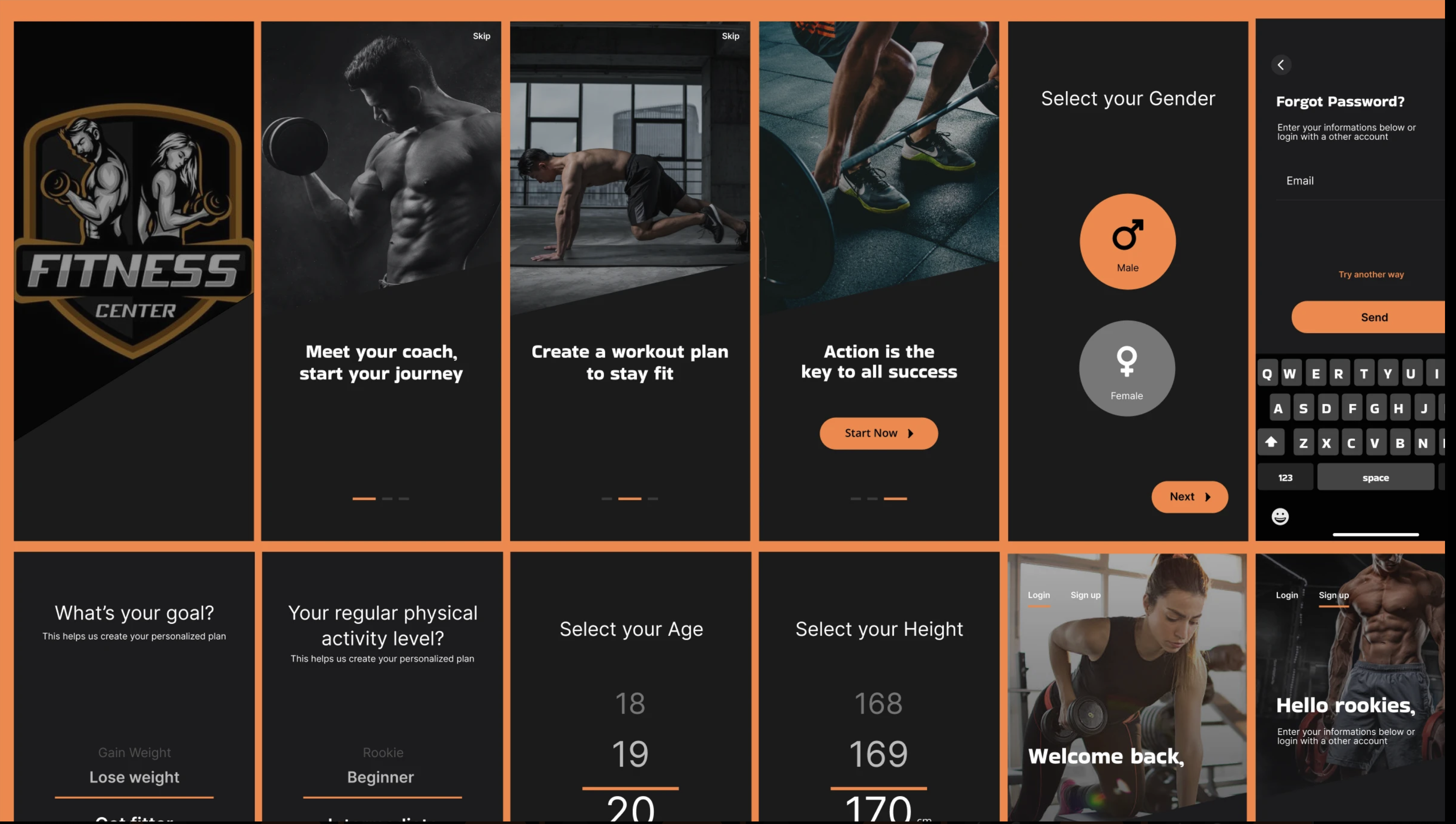
A dark interface was selected because it is commonly associated with fitness products and performs well in gym environments where lighting conditions vary. Bright orange was chosen as the primary accent color because it naturally communicates energy, motivation, and action while creating strong contrast against dark backgrounds.
Large imagery was used throughout the application to make workout programs feel more engaging and to reduce the amount of text users needed to read before taking action.
The onboarding process was intentionally divided into small steps rather than presenting users with one long registration form. This significantly reduces cognitive load and helps new users complete the setup process without feeling overwhelmed.
Workout programs were organized using visual cards and clear categories, allowing users to identify the right training plan in just a few seconds.
⸻
Technologies
Although my primary responsibility focused on product design, the project was prepared with a development-ready structure that could easily be implemented using modern web technologies.
Design
* Figma
* Auto Layout
* Components
* Variants
* Design Tokens
* Interactive Prototyping
Website
HTML5
CSS3
JavaScript
React
Next.js
Tailwind CSS
Mobile
React Native
Expo
Backend
* Node.js
* Express.js
Database
PostgreSQL
Authentication
JWT Authentication
Secure Login System
Email Verification
Deployment
Vercel
⸻
Problems & Solutions
During the design process, several usability challenges emerged.
The first issue was information overload during onboarding. Early prototypes required users to complete too many fields before accessing the application, making the experience feel slow and discouraging. This was solved by transforming the registration into a guided multi-step flow where users only focus on one decision at a time.
Navigation also became increasingly complex as new features such as coaching, exercise libraries, shopping, and profile management were added. To solve this, the application was reorganized around a simplified bottom navigation system with clearly separated primary sections, reducing the number of interactions required to reach important content.
Another challenge involved presenting a large amount of workout content without overwhelming users. Instead of relying on dense lists, visual workout cards with large images and concise information were introduced, making exploration much faster and more engaging.
Finally, maintaining consistency between the website and mobile application required the creation of a reusable design system. Shared typography, color tokens, spacing rules, components, and interaction patterns ensured that both platforms felt like parts of the same product rather than separate experiences.
⸻
Results
The final product successfully delivers a unified fitness platform that combines coaching, workout management, progress tracking, and e-commerce into one cohesive experience. The modular design system allows the platform to scale as new features are introduced while maintaining visual consistency across every screen.
The project demonstrates how thoughtful UX strategy and modern interface design can transform a complex product into an experience that feels intuitive, engaging, and easy to use.
⸻
What I Learned
Working on FitWave reinforced the importance of designing complete user journeys rather than isolated screens. It highlighted how research, structured information architecture, and reusable design systems contribute to scalable digital products. The project also strengthened my ability to balance business requirements with user expectations while designing for multiple platforms simultaneously.
⸻
Final Outcome
FitWave evolved into a complete digital fitness ecosystem that connects users, trainers, educational content, and online shopping through a consistent user experience. From the initial research phase to the final high-fidelity interfaces, every design decision was made with the goal of creating a product that feels modern, intuitive, and ready for real-world development.
Project Information
- Category
- Mobile App
- Last updated
- August 18, 2026